Federal Contractor
The Osage Group, LLC
Tulsa · Oklahoma
Osage
Peuple des Eaux du Milieu · People of the Middle Waters.
A 100% Native‑owned federal contractor — foundational AI and large language models, sovereign cryptography and post‑quantum systems, robotics & autonomy, and a sovereign cloud platform for the United States Government and allied defense.
Named for Maj. Gen. Clarence L. Tinker — first Native American Major General in U.S. Army history; lost at Midway leading the long‑range bombing sortie against Wake Island He had Himself planned.
Capabilities
Foundational AI & LLMs · sovereign cryptography · post‑quantum systems · mission‑class settlement · trusted identity · mission cloud · technical advisory. The full capability statement.
Read more
Past performance
Open‑weight Zen foundation models through Osage AI. Cryptographic research through Osage Institute. Sovereign settlement infrastructure through Osage Network. Trusted identity through Osage ID. Customers in defense, intelligence, and allied government.
Read more
Officers
Office of the Chief Executive — CEO H. “Smoke” Dupont, General Counsel Alan Donohue, International Counsel Serhiy Hromov, CIO HRH Cyrus Pahlavi, Chief Architect & Cryptographer Z. Kelling, Chief Education Officer Prof. Amii Omara-Otunnu Chief of Staff Ashlie Christie. Chairman Emeritus — Maj. Gen. Clarence L. Tinker, in memoriam.
Read more
§ I
For the contracting officer
The short version — full Capability Statement at /capabilities.
What we do
Foundational AI & LLMs · sovereign cryptography & PQ · robotics & autonomy · sovereign cloud (Osage Cloud) · sovereign settlement · trusted identity · technical advisory · international counsel.
Who buys
DoD, IC, DHS / CISA, DOE / NNSA & National Labs, federal civilian agencies, allied defense.
Standing differentiators
Tinker namesake heritage · Tulsa principal office · Native American–led · the Chief Architect & Cryptographer holds the standing PQ brief · UNESCO Chair on the Board.
First call
Contracting: [email protected]
Capture: [email protected]
Security: [email protected]
§ II
Federal posture
Capability statement, contract data, and the standing position from which Osage Group engages the U.S. Government and allied defense.
A full capability statement is published for contracting officers and program managers. Past performance, key personnel, and the corporate data sheet are at /capabilities. Contracting inquiries route to [email protected].
§ III
Delivery vehicles
The sister sites federal contracting actually engages with. The full umbrella ecosystem — commercial — lives at osage.group.
§ IV
Historic territory
The Wah-Zha-Zhe carry an inheritance of land far larger than the present reservation. The diagram below traces the cession history from the pre-1808 extent to the present 1.47-million-acre Osage Reservation in north-central Oklahoma.
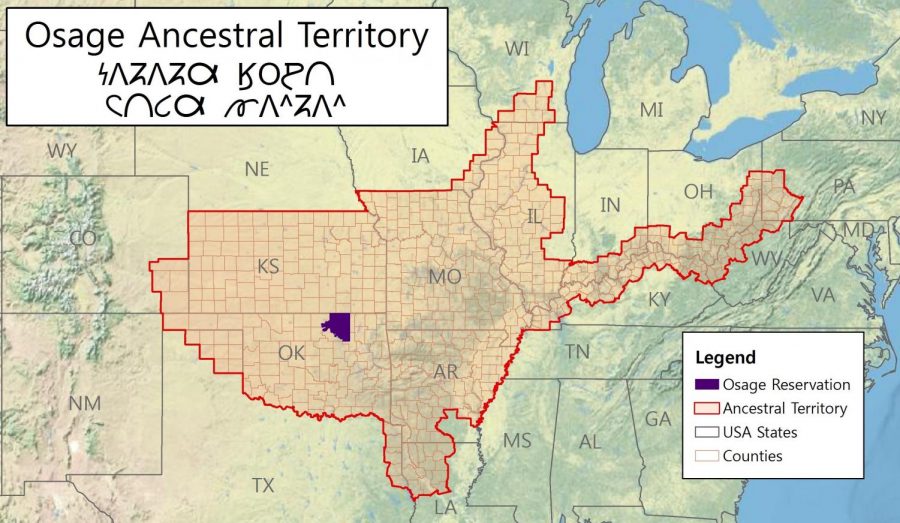
See /footprint for the full cession timeline (1808 → 2006).
§ V
What we stand on
The 1907 Allotment Act preserved a covenant unique among American Indian nations: the surface of Osage land was allotted, but the mineral estate beneath remained held in common. The discipline that protected that wealth — not to scatter what is sacred — is the operating principle of this house. We are a small group, deliberately. We hold long‑horizon capital, we keep the standing observances, we underwrite the next generation, and we coordinate standing partnerships in writing.
That same discipline is what we bring to the federal mission. The contracting interface is here at osage.global/capabilities; the commercial brand is at osage.group; the memorial to Maj. Gen. Tinker is at osage.memorial. Each lane keeps to itself.
A federally recognised sovereign tribal government, the Osage Nation, exists separately and speaks for itself at osagenation-nsn.gov. This site is not the Nation.
Wah‑Zha‑Zhe · People of the Middle Waters
The Osage Group is organised by descendants of the Osage Nation and named in memoriam for Maj. Gen. Clarence L. Tinker. The Osage Nation, a federally recognised sovereign tribal government seated at Pawhuska, Oklahoma, speaks for itself and is not bound by any commitment on this site. Wah‑Zha‑Zhe heritage is honoured here; sovereignty is respected at its source.